
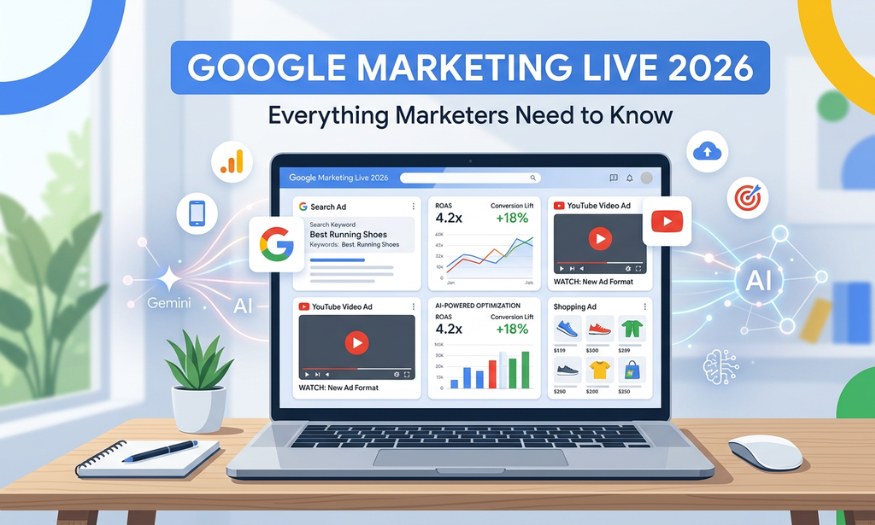
Google Marketing Live 2026 is over, and it left one clear message for marketers. AI is no longer a shiny add on. It is how Google Ads works by default. From Search to YouTube to shopping, Gemini is now built into the tools you use every day.
In this post, I will walk you through the most important announcements from Google Marketing Live 2026 and translate them into plain language. The goal is simple. If you run performance campaigns, you should be able to read this once and know what to test next.
Key Points: What changed at Google Marketing Live 2026
Search is shifting to AI powered experiences, and AI Max is becoming a core way to show up in them.
Asset Studio is now the main creative hub in Google Ads, with fast AI generated text, images and video.
Measurement is getting more predictive, so your data and tagging matter more than ever.
Agentic commerce is coming, powered by Universal Commerce Protocol and Universal Cart, so clean Merchant Center data is critical.
The marketer’s job does not disappear. It shifts toward better strategy, inputs and creative, while AI handles more execution.
The big picture: Search in the AI era
Vidhya Srinivasan, who leads Google Ads and Commerce, set the tone by saying that Google is not just putting ads into AI experiences, it is effectively reinventing what an ad should be in an AI first Search environment
Search behaviour has fundamentally shifted. Users are no longer typing short keyword phrases. They are asking long, complex, conversational questions in AI Mode and expecting rich answers, not a list of blue links. Gemini now helps match ads to the full context of those conversations, using more than just the raw query as a signal.
For you as an advertiser, this means success in Search now depends less on individual keywords and more on how well your campaigns, creative and data work with AI systems that understand the full context of each query.
The pace of change now makes the mobile shift look like molasses by comparison. Marketers who adapt their inputs and strategy stand to gain the most.
Announcement 01
Moving beyond keywords as the only anchor
Google is not killing keywords. They still matter for structure and reporting. However, they are no longer the only or main way Google reads user intent in many campaign types.
Products like AI Max use Gemini and a wide range of signals, including query context, landing page content and user behaviour, to match ads to the right people. This is especially important for long, conversational queries that are hard to cover with manual keyword lists.
Why AI Max and Performance Max are now the recommended routes
✓
Automated targeting that goes beyond exact matches and uses broader contextual understanding.
✓
AI assisted creative that adapts ad text to match the intent and language of each query in real time.
✓
Eligibility for new AI native ad experiences in Search that are designed for campaigns using AI powered features like AI Max.
The mindset shift: You still set direction with keywords and themes, but you let AI handle the messy details of matching against thousands of variations.
Announcement 02
Brand control inside AI automation
More automation naturally raises concerns about losing control over your brand. Google is addressing this with stronger brand controls, guidelines and brief-like inputs that let advertisers set clearer parameters around how their brand shows up
Creative messaging
Define what AI generated copy can and cannot say on behalf of your brand. Existing text guidelines and policies continue to apply to AI powered formats.
Audience guardrails
Set rules around who your ads should and should not reach. The AI works inside your constraints, not around them.
Brand voice
Ensure AI generated text stays on brand. You provide stronger inputs, AI scales within those boundaries.
Announcement 03
New AI native ad formats built for trust
Google is rolling out ad formats designed specifically for AI era Search. These formats aim to help users evaluate options and answer their questions, while still making it clear what is an ad and what is not.
Two formats worth knowing
| Format | What it does |
|---|---|
| AI generated ad explanations | Google is testing AI generated explanations that help users understand why an ad is relevant to their query, using Google’s understanding of the advertiser and the search context to improve clarity and trust. |
| Direct Offers | A format where users can only receive a better deal than what is publicly available. They cannot be charged more. It is built to surface value, not extract it. Google is expanding this as a priority experiment. |
Google’s internal research shows that more contextual and explanatory ad experiences increase trust and engagement, particularly when users understand why they are seeing a specific ad.
Announcement 04
YouTube: from awareness to full funnel performance
YouTube has always been strong for brand awareness. With the latest updates, Google is pushing it hard as a performance channel. The focus is on Demand Gen campaigns, new ad formats and Gemini powered tools that make creative and audience matching smarter.
✓
AI supported creator discovery. Gemini understands creators’ audiences and content style, then matches them to brands with aligned goals. Finding the right creator partnership is now faster and more scalable.
✓
Shoppable video experiences. As UCP and commerce features expand, YouTube on connected TV is becoming more shoppable, with formats that let viewers move from watching to exploring products and purchasing in a few steps.
✓
Stronger Demand Gen. Google continues to invest in Demand Gen as a full funnel channel, improving how it turns attention into measurable action for advertisers.
Announcement 05
Measurement: from report card to performance engine
Google is moving measurement beyond retrospective reporting, with new attribution views, branded search based signals and predictive models that help marketers understand future growth potential.
More granular attribution views that make it easier to isolate the role of campaigns like Demand Gen in your conversion paths, and to compare them fairly to other channels.
Metrics that track whether users search for your brand or product after seeing an ad, which Google highlights as highly predictive of future purchase intent.
Predictive models that combine post exposure signals, such as branded searches and engagement, to estimate future profitable growth, which is especially useful for longer sales cycles.
Announcement 06
Creative at scale with Asset Studio
Asset Studio is entering a new era. Google presents it as your creative home base inside Google Ads, with the ability to generate text, images and video from a single concept. You can also bring in assets from tools like Adobe and Canva and make them ad ready in just a few clicks.
What is new in Asset Studio
✓
AI powered generation. Go from a general concept to a full slate of headlines, descriptions, images, and videos across every aspect ratio in a fraction of the previous time.
✓
Proper A/B asset experiments. One click swaps out the creative variable and gives you a clean readout on incremental performance. No messy campaign duplication. No guesswork about what is actually driving results.
✓
Stakeholder sharing. Share creative previews with internal teams, legal or clients before ads go live. A significant workflow improvement for agencies and larger marketing teams.
Worth knowing: If an asset gets minimal impressions but is still driving performance, it is often reaching a niche audience that no other asset in your mix would have found. Creative is a targeting tool, not just a design task.
Announcement 07
Agentic commerce: Universal Cart, UCP and what it means for merchants
One of the bigger themes at Google Marketing Live 2026 is what Google calls agentic commerce. In this model, AI agents help users research, compare and buy products across Search, Gemini, YouTube and Maps using a shared commerce infrastructure.
Three pieces of the infrastructure to know
| Protocol | What it does |
|---|---|
| Universal Commerce Protocol (UCP) | The standard that defines how product and offer data flows into AI shopping experiences. |
| Agent Payments Protocol (AP2) | Supports payments inside agentic flows so users can complete purchases without friction. |
| Universal Cart | Lets users collect products from multiple merchants and complete purchases across Google surfaces consistently. |
What merchants should do now
✓
Keep your Merchant Center feed accurate and refreshed. This is the core data that powers your visibility in AI driven shopping and Universal Cart.
✓
Add conversational attributes including Q and A style content, detailed descriptions and reviews so AI driven experiences have more to work with.
✓
Invest in high quality images, video and copy that capture your unique brand voice. Diversity of assets matters as search becomes more multimodal.
What marketers should do right now
Every product leader at the event closed with one concrete action item for the week ahead. Here is the combined list.
Search and AI ads
Enable AI Max and related AI features in Search to participate in the new AI powered Search experiences and test formats like Direct Offers where available.
Creative
Get into Asset Studio and start experimenting with different creative messages. Make sure your measurement is set up to show what is actually driving business outcomes, not just clicks.
Measurement and data
Make sure your tagging is up to date, bring offline conversion data into your measurement setup, and explore the latest data linking options in Google Analytics and Google Ads.
Frequently asked questions
What is the biggest takeaway from Google Marketing Live 2026?
Google is rebuilding advertising around Gemini. Search, YouTube, creative tools and shopping all lean on AI by default. If you continue working as if this change has not happened, you risk losing ground to advertisers who adopt AI Max, Asset Studio and stronger measurement setups.
Do keywords still matter after Google Marketing Live 2026?
Yes. Keywords still help structure your account and send useful signals. However, they are no longer the only way Google understands intent. AI Max and other AI features focus more on context, themes and landing page quality than on long lists of exact match keywords.
I sell products online. What does agentic commerce mean for me?
More of your future customers will discover and buy through AI driven flows, not only through traditional search results or static ads. If you keep Merchant Center clean, enrich your product data and invest in quality assets, you give Google’s AI more reasons to surface your products when people are ready to buy.
What should a performance marketer test first after this event?
Two things. First, test AI Max where it makes sense so your campaigns can appear in new AI search experiences. Second, start using Asset Studio to ship and test new creatives faster. This combination alone can deliver quick wins while the rest of the roadmap catches up.
The bottom line
The marketer’s job is not going away. It is changing.
AI now handles more of the execution, including bidding, targeting and creative production. Your role shifts toward understanding your customers, shaping the strategy, feeding AI with high quality inputs and judging the results with a clear business lens.
As AI raises the baseline for every advertiser, standing out comes down to one thing. Know your brand better, express it more clearly in your creative and data, and use the tools Google gives you with intention. If you do that, AI becomes a force multiplier for your work.
Work with us
Not sure where to start with all of this?
Google Marketing Live 2026 brought a lot of change at once. AI Max, Asset Studio, new measurement metrics, agentic commerce. Knowing what to prioritise for your specific business is not always obvious.
We help businesses cut through the noise and act on what actually moves the needle. Book a free meeting with our team and we will look at your current setup, identify the gaps, and tell you exactly what to focus on first.